

A newly published scientific study reveals that invasive Burmese pythons do more than threaten native wildlife in South Florida; they may also be altering how plants spread across the landscape. Biologists Ian Bartoszek and Ian Easterling on the Conservancy of Southwest Florida’s python team are pleased to have contributed field data to “Double agents: invasive Burmese pythons and Argentine black and white tegus as potential seed dispersers in South Florida,” published in the Journal of Zoology in 2025.
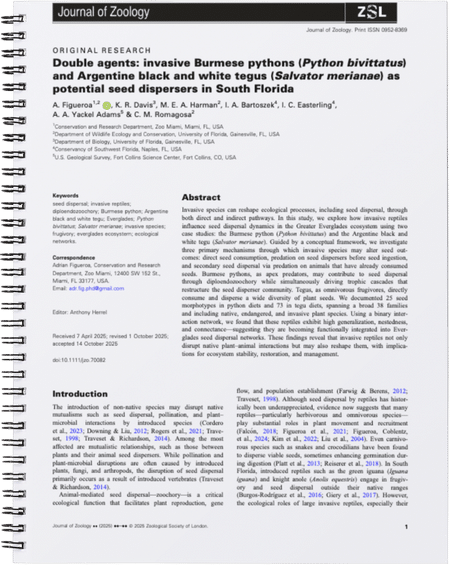
Led by researcher Adrian Figueroa and additional collaborators from the University of Florida and the U.S. Geological Survey, the study investigated seed dispersal caused by the two invasive reptiles. For years, the Conservancy team has collected stomach and digestive-tract contents from Burmese pythons, removed through ongoing management efforts in the Greater Western Everglades. Those samples helped document 25 different seed types inside pythons, including native Everglades species such as cabbage palm (Sabal palmetto) and creeping cucumber (Melothria pendula).
The findings suggest these large predators may act as unintentional “secondary seed dispersers.” When pythons eat mammals and birds that previously consumed fruit, some seeds can survive digestion and later be deposited in new areas. While only germination trials can confirm dispersal success, a Conservancy-supported test of Sabal palmetto seeds showed nearly 40% germination after passage through a python’s gut, indicating dispersal is likely occurring, according to the research.
Pythons have already driven severe declines in many native mammals that help disperse seeds. Now, their own movements may also be moving seeds across the landscape, including invasive plants that can take hold in sensitive habitats.
As this research shows, invasive species reshape ecosystems in ways that are not always obvious. By contributing critical field data, the Conservancy is helping scientists understand these impacts, informing management strategies to better protect the wildlife and fragile habitats of Southwest Florida. If you want to see other scientific papers the Conservancy has contributed to regarding invasive species, please click here.